
Warburg Pincus lifts its Ingenia proposal a third time
On 28 September, Warburg Pincus raised its non-binding, all-cash proposal for ASX-listed Ingenia Communities to A$5.25 per stapled security, after earlier offers of A$4.75 and A$5.05. Reports value the latest proposal at roughly A$2.14 billion. The proposal remains conditional on Ingenia terminating its agreed acquisition of Perth-based residential land developer Peet Limited, and Warburg set a 2 October deadline for the board to grant due diligence access. At the time of reporting the board had not formed a view or made a recommendation. Ingenia operates around 39 holiday parks alongside its land lease communities.
MLSP analysis: whatever the outcome, three successive increases from a global investor is a useful third-party signal of how institutional capital values this part of the accommodation market.
WA posts a record tourism year
The Australian Hotels Association (WA) welcomed record 2025 tourism results on 17 September: $19.2 billion in visitor spending, 11 million overnight visitors, and $6 billion spent in regional Western Australia. The release noted that WA’s geographic isolation means visitation depends on deliberate investment in major events and marketing, and that strong regional spending shows tourism benefits reaching beyond Perth.
MLSP analysis: for regional accommodation owners, it is a current, WA-specific measure of demand.
Discovery Parks buys into West Busselton
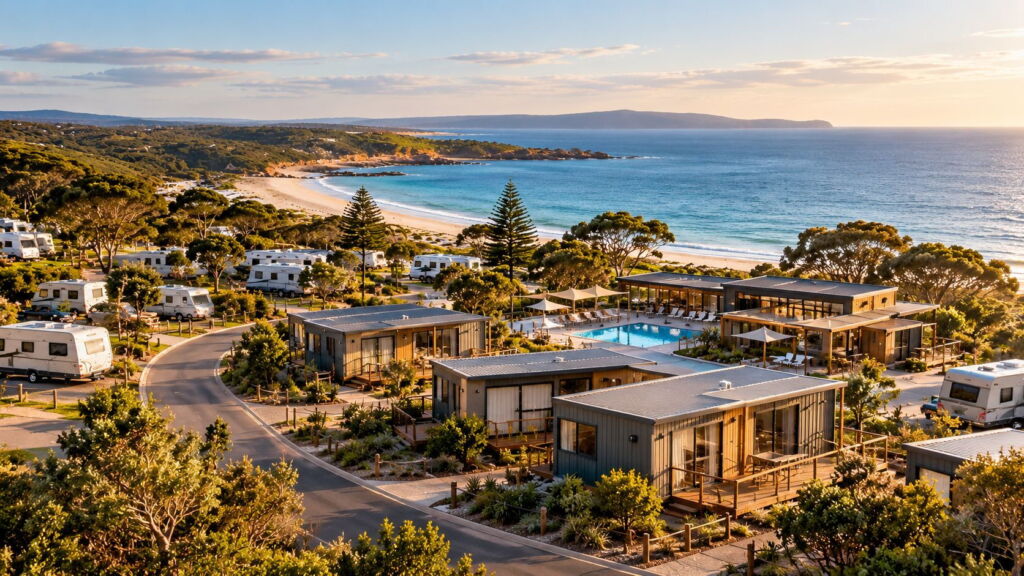
Reported in late August, Discovery Parks (part of G’day Group) has reached 101 owned properties after acquiring four former Breeze Holiday Parks, including West Busselton in WA. The company has indicated up to $250 million a year for regional acquisitions and upgrades, and a target of doubling the business by 2031. Coverage describes holiday parks moving from basic caravan sites to resort-style destinations with deluxe cabins and pools.
MLSP analysis: it is a month-old story, but it shows who is investing in WA’s regional parks.
Background: what the CEDA report says about modular building
A CEDA report covered in May found modular methods account for only about 5% of new Australian home builds, that modern methods of construction could cut build times by 20 to 50%, and that costs could fall by around 20% at scale. CEDA recommended harmonised transport permit requirements for prefabricated modules, standardised finance products and removal of National Construction Code barriers.
MLSP analysis: these are recommendations, not changes in force, but they show the direction of the policy conversation.
The MLSP model, in brief
MLSP helps WA caravan and holiday park owners add modular cabin accommodation to their own sites. The cabins are manufactured off-site and installed on your land, and the investment and booking income are shared between the park owner and a network of co-investors, so owners can upgrade without selling their park. With visitor spending at record levels and larger operators buying and upgrading parks, it’s a reasonable time for independent owners to look at their options.
We’re not saying it’s the only way to respond. It’s simply one option worth knowing about.
Questions about how these changes affect your park, or curious how the MLSP model works in practice? Reach out at info@mlsp.au or visit mlsp.au. No obligation either way.