
A $120 million federal loan cements backing for a WA modular apartment factory
The National Reconstruction Fund Corporation (NRFC), the Commonwealth’s sovereign manufacturing investment vehicle, has confirmed a $120 million loan to Built Living, the joint venture between Wesfarmers (owner of Bunnings, Kmart and Officeworks) and construction contractor Built, to support its advanced manufacturing facility at Neerabup, north of Perth. The loan sits alongside Wesfarmers’ own $100 million equity commitment and a $20 million WA government grant and land contribution, taking total backing for the facility into the hundreds of millions.
The factory will produce prefabricated concrete, plumbing and electrical components for mid-to-high-rise apartments, targeting around 2,000 apartment units a year once production begins in 2028, at a projected 20 per cent lower cost and roughly half the build time of conventional construction. NRFC CEO David Gall said the investment would “really boost the supply of housing” and create “well-paid jobs” with “career pathways”.
MLSP analysis: it is worth being precise that this is apartment-scale manufacturing rather than a cabin-scale competitor, but the scale of capital now backing modular construction in WA (Commonwealth debt, corporate equity and state grants together) is a useful credibility reference point when discussing modular investment more broadly.
RBA holds rates at 4.35 per cent, keeping the door open to further hikes
The Reserve Bank of Australia held the cash rate at 4.35 per cent in a unanimous decision on 11 August, following three rate increases earlier in 2026. Governor Michele Bullock said the board remains focused on inflation risk and explicitly kept the door open to further hikes rather than cuts. The board only considered holding or raising at this meeting.
Underlying inflation remains elevated even as property prices have declined more than expected, with the RBA’s updated forecasts showing inflation only returning to its 2.5 per cent midpoint target by early 2028.
MLSP analysis: for prospective investors, a hawkish rate environment sharpens the relative appeal of co-investment structures that do not require taking on additional mortgage debt, a distinction worth drawing out directly in investor conversations rather than assuming it is obvious.
South Australia becomes the fourth state to commit to binding prefab procurement
South Australia’s Housing Trust has launched a tender for 120 turn-key prefabricated homes to be delivered over four years across regional and metropolitan sites, modelled on Queensland’s school-building procurement approach. Alongside the tender, a $2.15 million modular display village of six completed homes will showcase factory-built housing quality to government agencies, councils and investors before the homes are relocated to regional communities under the Regional Key Worker Housing Scheme.
Separately, AMPLIFY-commissioned research found 73 per cent of South Australians support expanding the use of prefab housing. With this announcement, South Australia becomes the fourth state, after New South Wales, Queensland and Victoria, to make a binding procurement commitment to modern methods of construction (MMC) in 2026.
MLSP analysis: the pattern reinforces that prefabrication is now central to housing policy nationally, not only in Western Australia.
Ingenia Communities’ FY26 results show holiday park bookings running 5 to 8 per cent ahead
ASX-listed Ingenia Communities (ASX:INA) issued an FY26 trading update guiding to the top of its earnings range, with EBIT of $180.5 million to $188.7 million and 560 to 575 home settlements expected for the year. Within its holiday parks business, Ingenia reported that Easter occupancy and room rates rose year-over-year and that spring and summer bookings are currently running 5 to 8 per cent ahead of the prior year, even as it acknowledged shorter booking lead times and cost and fuel pressures consistent with a cautious consumer environment.
Ingenia’s core living portfolio now spans more than 8,800 homes with 97 to 99 per cent occupancy across its communities, and its development pipeline exceeds 8,000 potential land-lease lots, with the company targeting 10 to 15 per cent compound annual settlement growth through FY29.
MLSP analysis: taken together, those figures are a healthy, national-scale demand signal for the regional accommodation sector MLSP operates in.
What park owners may consider
- Federal, state and corporate capital is now committed to modular manufacturing capacity in Western Australia, but the Neerabup facility is scaled for apartments and is not scheduled to begin production until 2028, so it does not change cabin supply in the near term.
- A hawkish rate environment affects how any accommodation addition is financed. Structures that do not require additional mortgage debt sit differently on a balance sheet to those that do, though the right approach depends on a park’s own position.
- National holiday park demand indicators are positive, but they are drawn from one large listed operator’s portfolio and do not establish what demand will do at any particular Western Australian site.
- Program details, tender terms and rate settings referenced above are as reported on the dates shown, and should be checked against the relevant source before being relied on.
The MLSP model, in brief
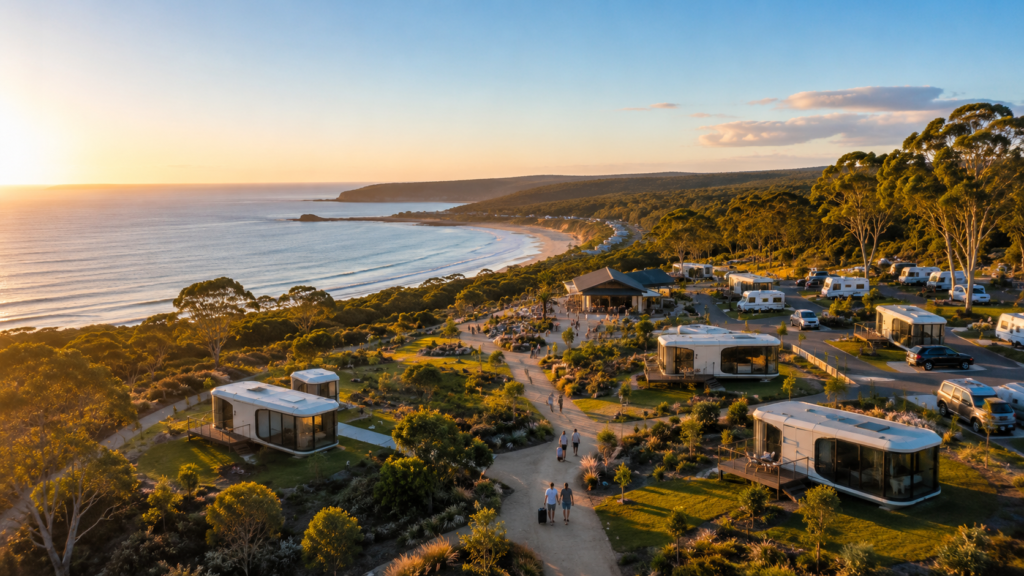
MLSP helps WA caravan and holiday park owners add modular cabin accommodation to their parks, supplied by our manufacturing partner and installed on-site, with capital and revenue shared between the park owner, the manufacturer and an investor. With federal and state governments backing modular construction at serious scale, and national holiday park demand still climbing, it is a genuinely good moment for independent park owners to explore what a cabin addition could look like on their own site, without giving up ownership of the park itself, and without needing to solve every one of these pressures alone.
We are not going to tell you it is the only way to respond to these trends. It is simply one option worth knowing about if regional WA accommodation is of interest.