
Ingenia opens its books to Warburg Pincus
Following Warburg Pincus’s third proposal at A$5.25 per stapled security (about A$2.14 billion), Ingenia Communities announced in the week of 5 October that it has granted Warburg initial, non-exclusive due diligence access. The board stressed this is “not an endorsement”: it has not concluded the offer is superior and has not said it will recommend it. Ingenia is continuing to progress its agreed acquisition of Perth land developer Peet Limited in parallel, and Warburg’s proposal only works if that deal is terminated. Warburg is expected to reconfirm its proposal about a fortnight after gaining access, and the Peet scheme meeting and court hearing are scheduled for early December 2026.
MLSP analysis: Ingenia operates around 39 holiday parks, so the outcome will decide who owns one of the larger national holiday park portfolios.
54 modular homes for the Wheatbelt
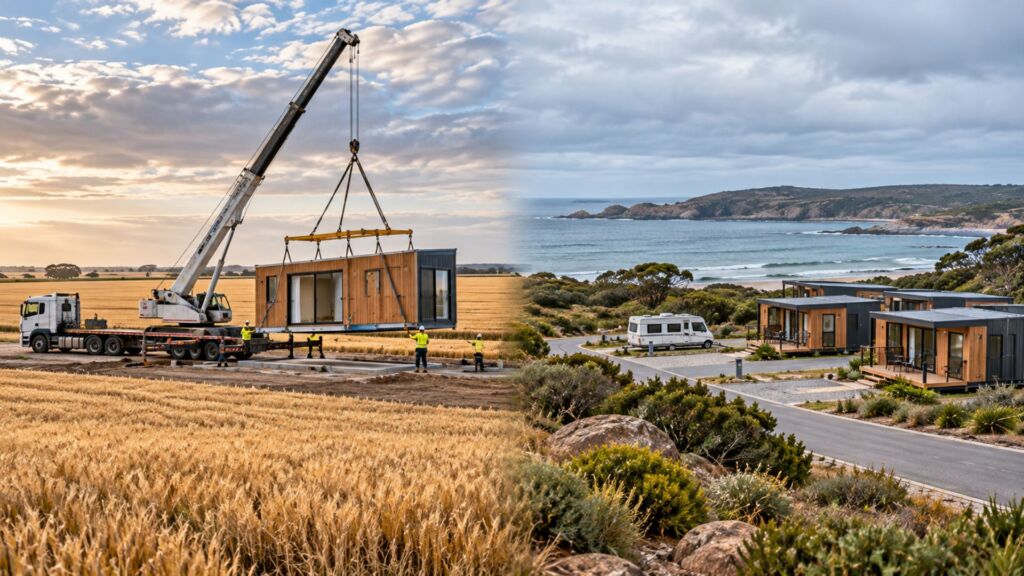
Reported in August, WA and the Commonwealth are funding 54 modular homes for seniors across 17 sites in 11 Wheatbelt shires, including Merredin, Kellerberrin, Bruce Rock and Dowerin, in a A$27.2 million package. The two-bedroom units are built at a Perth factory, with on-site installation later in 2026. It is described as the largest single delivery of modular social housing by a community housing provider in WA.
Separately, a A$220 million modular housing factory is planned at Neerabup in outer Perth, backed by a A$120 million National Reconstruction Fund loan. Its claimed benefits (up to 50% faster builds and up to 20% lower costs) are projections, not yet proven.
MLSP analysis: together, the two projects show factory-built accommodation being delivered to regional and metropolitan WA sites.
What WA’s planning reforms do and don’t cover
On 28 July 2026 the WA Government announced planning reforms including extending the single-house planning exemption to up to four grouped houses and apartments that meet planning standards, a 28-day deadline for local governments to respond to engineering drawings, and more concurrent scheme amendments. The announcement does not mention modular housing, caravan parks or tourism accommodation, so the direct effect on park cabins is unclear.
For reference, the 2024 changes to the Caravan and Camping Grounds Regulations let local governments approve temporary accommodation on private land for up to 24 months, with each council setting its own policy.
MLSP analysis: for park owners, the local shire’s current position remains the practical starting point.
A record year, and a quiet winter
WA’s 2025 tourism year was a record (A$19.2 billion in visitor spending, A$6 billion of it in regional WA). But ABC News reported on 22 July that Great Southern businesses in Denmark, Albany, Bremer Bay and Augusta saw noticeably fewer winter visitors, with one Albany operator at about half capacity and Augusta operators reporting far fewer caravans and campervans. Cited causes were cost-of-living pressure, fuel prices, uncertainty over diesel supply and late bookings.
MLSP analysis: these are business-level reports, not region-wide statistics, but they show that demand is strong yet seasonal and price-sensitive.
The MLSP model, in brief
MLSP helps WA caravan and holiday park owners add modular cabin accommodation to their own sites. The cabins are manufactured off-site and installed on your land, and the investment and booking income are shared between the park owner and a network of co-investors, so owners can upgrade without selling their park. Cabins can appeal to visitors who travel without a caravan or campervan, which may help a park reach a wider group of guests through the year.
It is one option among several, and not the right fit for every park. It’s simply worth knowing about.
Questions about how these changes affect your park, or curious how the MLSP model works in practice? Reach out at info@mlsp.au or visit mlsp.au. No obligation either way.