
Ingenia Opens Its Books Wider to Warburg Pincus
On Tuesday 20 October 2026 Ingenia Communities told the ASX it had granted Warburg Pincus comprehensive due diligence access, expanding the initial non-exclusive access opened on 5 October. The parties were working toward a process deed by Friday 23 October and described “considerable progress”. Warburg’s proposal remains A$5.25 cash per stapled security (about A$2.14 billion), with securityholders able to keep a half-year distribution of up to A$0.05 without a price reduction.
The proposal remains non-binding and conditional. Ingenia has not terminated its agreed acquisition of Perth developer Peet Limited, and ending that arrangement would be a condition of any binding Warburg deal. Ingenia operates around 39 holiday parks, so the outcome will influence how large investors view the sector. A process deed is simply an agreement that sets the rules for due diligence; it does not mean a deal will happen.
Interest Rates at a 15-Year High
The Reserve Bank’s Monetary Policy Board raised the cash rate by 25 basis points to 4.60% on 29 September 2026. Minutes released on 13 October said inflation risks had grown and that the board would act, including raising rates further if required. Markets were pricing a modest chance of another rise in November, and September-quarter inflation data is due on 28 October.
The RBA’s October Financial Stability Review also describes a housing downturn, with house prices down six months in a row and falls of up to 15% forecast. It reports that fewer than 2% of variable-rate owner-occupier borrowers have a cash flow shortfall and that most hold buffers of more than a year of repayments. For anyone planning to fund new accommodation, the practical point is to test the numbers against higher borrowing costs. (General information only, not financial advice.)
What Europe’s Modular Builders Are Learning
A preview of the third World of Modular Europe event (Amsterdam, 12–14 October 2026) highlighted lessons relevant to Australia. Canada’s CSA Group released a volumetric modular design standard (CSA Z251) on 22 September. In the Netherlands, temporary “flex housing” for social rental shows that procurement commitments from government, rather than product alone, are what let factories scale. A Swedish firm reports lifting output from 14 to 42 modules a week while cutting staff-hours per module from 187 to 94 (company-reported and not independently verified).
For Australia, the article notes that the national voluntary certification for modular manufacturers is due from mid-2028, and that developers still struggle to get modular projects financed. Governments buying crisis, social and key-worker housing could provide the long-term volume that unlocked factory investment overseas.
The MLSP Model, in Brief
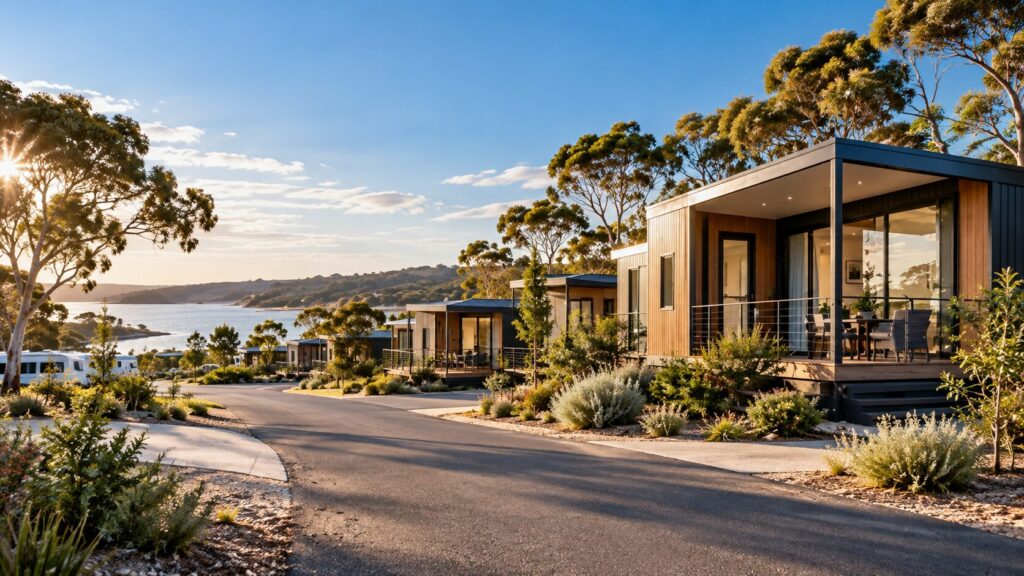
MLSP helps WA caravan and holiday park owners add modular cabin accommodation to their own sites. The cabins are manufactured off-site and installed on your land, and the investment and booking income are shared between the park owner and a network of co-investors. That structure means owners can add accommodation without carrying the full cost, and without selling their park.
It is one option among several, and not the right fit for every park. It’s simply worth knowing about.
Questions about how these trends affect your park, or curious how the MLSP model works in practice? Reach out at info@mlsp.au or visit mlsp.au. No obligation either way.