
What happened
On 5 August 2026, G’day Group announced the acquisition of four Breeze Holiday Parks: Halls Gap and Grampians in Victoria, Katherine River in the Northern Territory, and West Busselton in Western Australia. The transaction took the Discovery Parks network past 100 locations nationally, in a reported investment of more than $40 million spanning purchase and asset upgrades.
Founder and Chief Executive Grant Wilckens said the company is setting its sights on doubling in size by 2031, toward a $4.5 billion market-leader position, with up to $250 million planned for investment each year in further acquisitions and flagship properties.
G’day Group, majority owned by Australian Retirement Trust, said the Breeze acquisition is expected to contribute more than $50 million in annual economic benefit and support over 420 full-time jobs.
The move follows the group’s April 2026 acquisition of Wintersun Caravan and Tourist Park in Carnarvon, Western Australia, now Discovery Parks Carnarvon, where the company flagged an initial investment of approximately $1 million and explicit plans to install more cabins to attract a broader demographic of traveller.
MLSP analysis
The following is MLSP’s interpretation of the above, not reported fact.
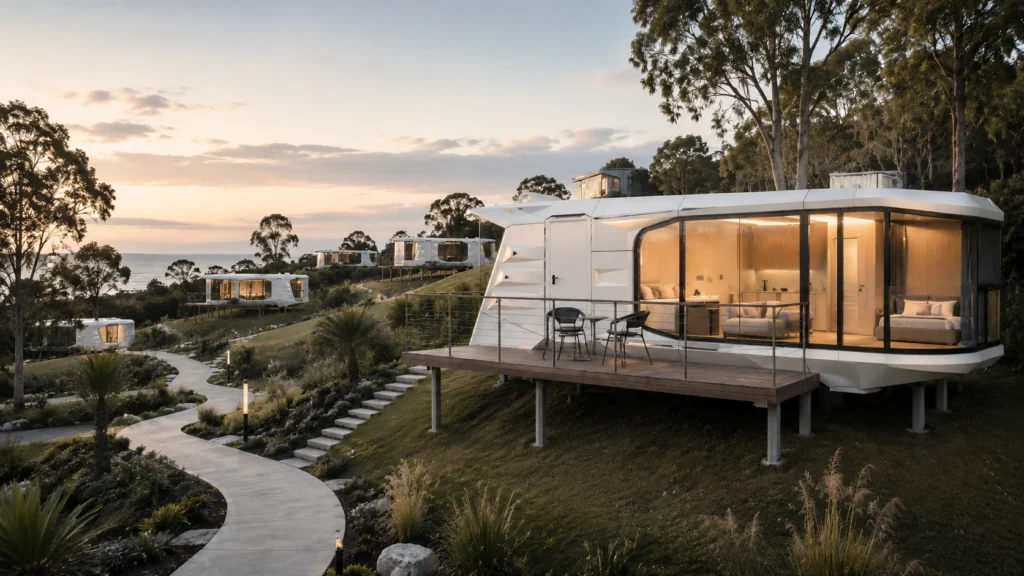
The most instructive detail is not the headline number of properties. It is the stated intention to add cabins at a newly acquired Western Australian park.
That tells you what a well-capitalised operator does when it takes over a regional park: it increases fixed-roof accommodation. Cabins broaden the guest base beyond travellers who arrive with their own van, and they lift revenue per site. A group with a $250 million annual acquisition budget is making that calculation deliberately and repeatedly.
For an independent WA park operator, this cuts two ways. Guests increasingly encounter a consistent cabin standard across group-owned parks, which raises the baseline expectation at every park they visit afterwards. At the same time, the capital and delivery capability required to respond to that expectation is exactly what an independent operator is least likely to have sitting available.
What park owners may consider
- Guest expectations of cabin accommodation standards may be shaped increasingly by group-owned parks, regardless of an individual park’s own positioning.
- Adding accommodation capacity is a capital and delivery question before it is a marketing one, and the structures available to fund it vary widely.
- Consolidation activity is a market signal, not a reason to move quickly on a project that does not stand up on its own site-specific numbers.